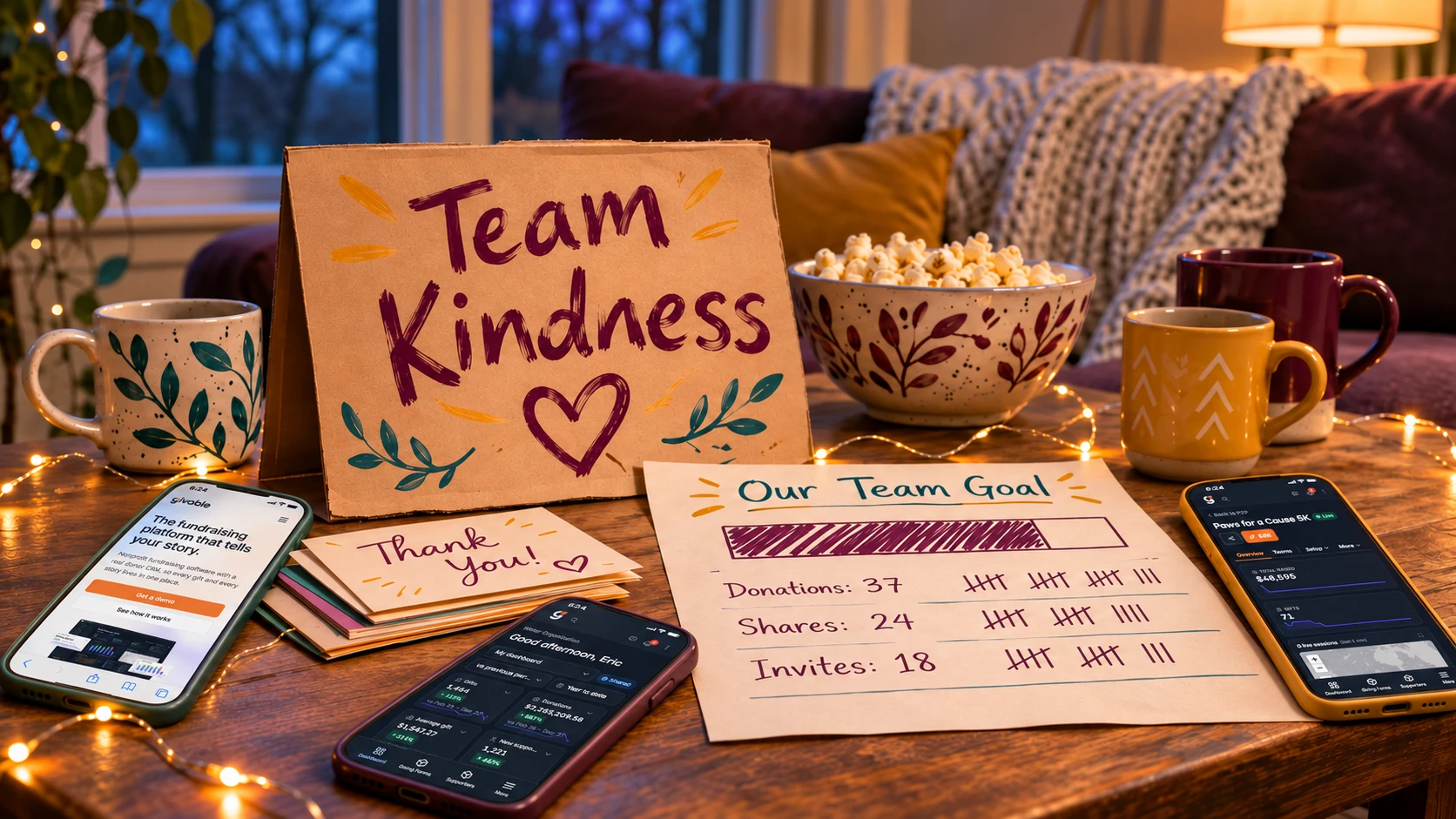
Every nonprofit has one. The volunteer who texts you photos from the 5K. The donor who mentions you at every dinner party. The board member’s cousin who ran a lemonade stand for you, unprompted, in 2019.
These people are already fundraising for you. They just don’t have a page, a goal, or a deadline yet.
GivingTuesday peer-to-peer fundraising gives them all three. You recruit a small group of ambassadors, give each one a personal fundraising page and a ready-made toolkit, and they ask their own friends and family to give on December 1, 2026. Your organization runs the campaign. Your ambassadors run the asking.
This post is the playbook: who to recruit, what to hand them, and a four-week timeline starting this week.
Why a friend’s ask works on GivingTuesday
On December 1, your supporters’ inboxes and feeds fill with appeals from organizations. Most of them blur together.
A message from a friend does not blur. As GivingTuesday’s own research on peer-to-peer fundraising puts it: “A peer’s ask becomes a powerful substitute for the brand doing the asking.”
That matters right now because the donor base is shrinking. The Fundraising Effectiveness Project reported that 2025 dollars grew 5.0% while the number of donors fell 3.6%. You will not reverse that by emailing the same list harder. Ambassadors reach people who have never heard of you, through someone they already trust.
GivingTuesday’s nonprofit toolkit makes the same point for smaller organizations: supporters and ambassadors are one of the best ways to reach new donors.
Recruit the right ambassadors (not the most famous ones)
The instinct is to chase the local news anchor. Resist it.
The best GivingTuesday ambassadors are people who:
- Already care, visibly and personally
- Have a network that trusts them (a book club counts, follower count does not)
- Will actually send a text when you ask them to
- Can tell a 30-second story about why they support you
Where to find them: monthly donors, long-time volunteers, board members, past event participants, alumni of your programs (with care and consent), and staff who want to take part.
How many: start small. Ten committed ambassadors who each raise $500 beat 100 sign-ups who never share their page. For a first GivingTuesday peer-to-peer campaign, aim for 10 to 25.
How to ask: personally. A one-to-one email or call, not a mass “become an ambassador!” blast. Try:
Hi Dana, you’ve volunteered at the Saturday pantry for three years, and I think your friends would listen to you more than they’d listen to us. Would you be one of 15 GivingTuesday ambassadors? It’s about two hours of effort, spread across a week. I’ll give you everything you need.
Notice what that ask does: it names their specific connection, makes the commitment concrete, and promises support.
The supporter toolkit: everything they need in one place
Ambassadors don’t quit because they stop caring. They quit because they don’t know what to say. Your job is to remove every blank page.
Here is the toolkit outline. Build it once and send it as one email with links, so ambassadors never have to dig for anything.
1. Their personal fundraising page, already set up
Pre-fill the page with your campaign story, a suggested goal, and a default photo. Then ask them to change two things: the photo and the first line (“Why I give”). That’s it.
Suggested goals: offer three tiers, like $250, $500, and $1,000. A ready-made number is easier to commit to than a blank box.
2. A “why I give” prompt
Most people freeze when asked to write about themselves. Give them a fill-in-the-blank:
I support [organization] because [one specific moment you saw or heard about]. This GivingTuesday, I’m trying to raise [goal] to help [specific outcome]. Would you join me?
Before:
Please donate to this great organization that does important work in our community.
After:
I’ve packed food boxes at the pantry every Saturday for three years. Last month a mom told me it was the first time her kids had fresh fruit all week. I’m raising $500 to keep those boxes full this winter. Will you chip in?
3. Ready-to-send messages for every channel
Write these for them, in their voice, and let them edit:
- Personal text (short, for close friends and family)
- Email (a slightly longer version with the story)
- Social post (with an image sized for each platform)
- Day-of reminder (“It’s GivingTuesday! I’m at $320 of $500.”)
- Thank-you message for their own donors
4. A simple calendar
Tell them exactly when to do what. Four dates is plenty: set up the page, soft launch to closest friends, the big December 1 push, and the December 2 thank-you.
5. The FAQ they’ll get asked
Is my gift tax-deductible? Where does the money go? Can I give by check? Give ambassadors the answers so they don’t have to email you at 9pm on GivingTuesday.
6. A human to call
One named staff contact with a phone number. Ambassadors who feel supported keep going. Ambassadors who feel alone go quiet.
The four-week launch timeline
This assumes you’re starting in early November for Tuesday, December 1, 2026. Tight, but doable.
| Week | Dates | Your organization | Your ambassadors |
|---|---|---|---|
| 1 | Nov. 5 to 11 | Set the goal, build the campaign page and fundraiser template, write the toolkit, make your ambassador list | Nothing yet |
| 2 | Nov. 12 to 18 | Personal recruitment asks, send toolkit to anyone who says yes, host a 20-minute kickoff call | Say yes, set up their page, change the photo and “why I give” |
| 3 | Nov. 19 to 25 | Seed each page with a small first gift or a staff gift if possible, share a leaderboard, check in personally | Soft launch to 5 to 10 closest people, aim to get the first few gifts in before Thanksgiving |
| 4 | Nov. 26 to Dec. 1 | Send “tomorrow’s the day” reminders, prep real-time updates, staff the phones | Big push on December 1: morning post, midday reminder, evening “final hours” message |
| After | Dec. 2 to 4 | Thank every ambassador personally, share the total, thank their donors | Thank their own donors and share the result |
Why the soft launch matters: a page with $0 raised looks abandoned. A page with $150 from four friends looks like momentum. Getting the first gifts in during week 3 means every ambassador walks into December 1 with social proof.
Keep the energy up on the day
On December 1, your ambassadors are your sales team, and you are their coach.
- Morning: send every ambassador a “we’re live” text with their page link
- Midday: share the leaderboard and celebrate the first person to hit their goal
- Afternoon: personal nudges to ambassadors who haven’t shared yet (“Want me to send you a ready-made post?”)
- Evening: a final-hours message they can forward in one tap
- Before midnight: the total, with thanks by name (with permission)
Leaderboards help, but keep them friendly. Celebrate “most donors” and “first to goal,” not just “most raised,” so the ambassador with a smaller network still gets a win.
After the day: keep every new donor you just met
This is where peer-to-peer either builds your donor base or quietly leaks it.
People who gave through an ambassador gave to their friend first and to you second. They need two thank-yous: one from their friend and one from you that introduces your organization.
Make sure every gift is attributed to the right ambassador and campaign in your donor database. Then:
- Thank each ambassador personally within 24 hours, with their total and the number of new people they brought in
- Send their donors a welcome email that tells the story your ambassador told, from your side
- Invite your strongest ambassadors to do it again for a spring campaign, while the high is fresh
The longer arc is in our donor retention guide.
What success looks like
Picture a youth sports nonprofit that recruits 15 ambassadors. Twelve set up their pages. Ten soft-launch before Thanksgiving. On December 1, the group raises $7,800 from 190 donors, and 140 of those donors have never given before.
The money is good. The 140 new names are better. Those are people who now know your organization because someone they trust vouched for you.
Without ambassadors, the same organization would have emailed its existing list a third time and hoped.
Your next step
This week, write down 20 names of people who already talk about your organization without being asked. Pick your top 15 and draft the personal ask using the example above.
Then start the toolkit. If you only build one piece, make it the “why I give” prompt and the ready-to-send text message. Those two pieces carry most of the load.
For the full GivingTuesday strategy, see the complete GivingTuesday 2026 guide. Before the day, run through the year-end donation form checklist.
Givable’s peer-to-peer fundraising gives every supporter a personal page with a photo, a goal, and one-tap sharing, with team and individual leaderboards. Every gift runs through the same checkout and lands in the same donor record, attributed to the fundraiser and the campaign, so the thank-you plan above is easier to run.
Frequently asked questions
What is GivingTuesday peer-to-peer fundraising?
It is a GivingTuesday campaign where supporters (ambassadors) create personal fundraising pages and ask their own networks to give to your organization on December 1. You provide the page, story, and messages. They provide the trust and the reach.
How many ambassadors do we need?
For a first campaign, 10 to 25 committed ambassadors is a good range. A small, well-supported group usually outperforms a large group that signs up and never shares. Recruit personally and support each person directly.
Is it too late to start peer-to-peer in November?
No, if you keep it simple. A four-week timeline from early November works when you recruit personally, hand ambassadors a finished toolkit, and get first gifts on their pages before Thanksgiving. Cut anything that requires custom design or approvals.
How do we thank donors who gave through an ambassador?
Give them two thank-yous: the ambassador thanks them as a friend, and your organization thanks them with a short welcome that explains your work. Make sure each gift is attributed to the right fundraiser so you can follow up accurately.