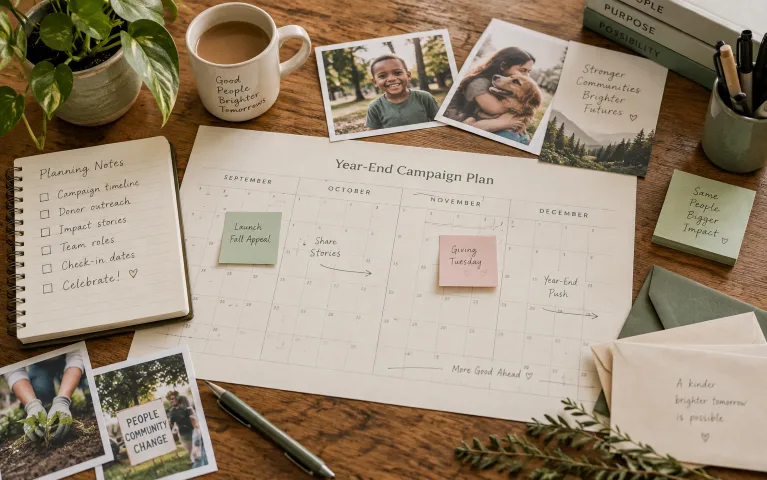
A year-end campaign is easier to run when every week has one job.
This calendar breaks the 2026 season into weekly tasks, from strategy in late September to stewardship in mid-January. It is the operating companion to The 2026 Year-End Fundraising Guide for Nonprofits, which covers the strategy behind each step.
The timing matters because giving is concentrated at the end. M+R Benchmarks 2026 reported that 37% of 2025 online revenue arrived in December, 10% in the final week, and 4% on December 31 alone. Everything before December exists to make those weeks work.
The key dates for 2026
| Date | Day | Why it matters |
|---|---|---|
| Nov. 26 | Thursday | Thanksgiving (U.S.). Plan around the holiday weekend. |
| Dec. 1 | Tuesday | GivingTuesday |
| Dec. 28 | Monday | Start of the final week |
| Dec. 31 | Thursday | Last day for gifts in the 2026 tax year |
| Jan. 1 | Friday | Stewardship begins |
Because December 31 falls on a Thursday, the final push runs Monday through Thursday. Staff your donor service and gift processing for those four days, not the weekend.
How to use this calendar
Each week lists a focus and a short set of tasks. Assign one owner to every task this week, and add a due date.
If your team is small, merge rows rather than skipping them. A shorter campaign with every piece in place beats a longer one with gaps.
Late September: strategy
Week of Sept. 21: set the plan
Focus: decide what the campaign is before anyone writes a word.
- Set the revenue goal, plus donor, reactivation, and recurring goals
- Choose the one campaign idea: the need, the outcome, and the donor’s role
- Name an owner for email, social, mail, web, and stewardship
- Block the key dates above on the team calendar
Week of Sept. 28: define audiences
Focus: know who you are talking to.
- Pull your segments: current, first-time, recurring, lapsed, major, event, and volunteer
- Decide which segments get their own version of each message
- Check that donor records are clean enough to segment (duplicates, missing emails)
- Review last year’s results by segment and channel
A useful nonprofit CRM makes this week an hour of filtering instead of a week of spreadsheet work.
October: build and produce
Week of Oct. 5: collect stories
Focus: gather the material every channel will use.
- Collect an opening story, a proof story, and a thank-you story
- Get photo and quote permissions now, not in December
- Draft the case for support in one page
- Decide what “progress” updates you can honestly report during the campaign
Our nonprofit storytelling guide has a framework for turning real moments into donor-centered stories.
Week of Oct. 12: build the giving path
Focus: the campaign page and donation form.
- Build or refresh the campaign landing page
- Set suggested amounts and make the recurring option visible
- Add gift instructions for DAFs, stock, checks, and ACH
- Test the form on a phone: speed, fields, payment options, and receipt
Use the donation-form conversion guide as your checklist.
Week of Oct. 19: write the core messages
Focus: draft once, adapt everywhere.
- Draft the launch, story, proof, deadline, and final-reminder emails
- Draft the direct mail appeal, if you send one, and set its drop date
- Write social posts for each campaign phase
- Draft thank-you messages and the recurring-donor welcome
Week of Oct. 26: review and set up tracking
Focus: quality before volume.
- Review every message for one clear ask and one clear link
- Set up tracking so you can report revenue by channel and segment
- Prepare board and ambassador materials: talking points, sample messages, and links
- Confirm who approves last-minute changes in December
November: warm up and prepare GivingTuesday
Week of Nov. 2: cultivate
Focus: give before you ask.
- Send an impact update to current and lapsed donors
- Share a story post on social and your site
- Start personal outreach to major and leadership donors
- Invite past donors to consider monthly giving, framed around continuing impact
For the monthly ask, see story-driven recurring giving that sticks.
Week of Nov. 9: lock GivingTuesday
Focus: decide GivingTuesday’s role in the season.
- Choose its job: launch, acquisition day, matching challenge, or peer-to-peer push
- Secure any match and confirm its terms in writing
- Recruit peer-to-peer fundraisers or ambassadors and send them their kit
- Schedule December 1 messages and progress updates
Week of Nov. 16: test everything
Focus: find the problems while there is time to fix them.
- Make a real test gift on mobile and desktop
- Confirm receipts, confirmation pages, and donor records all work
- Send test emails to staff across devices and inboxes
- Confirm the campaign page shows progress correctly
Week of Nov. 23: Thanksgiving week
Focus: light-touch and ready.
- Send a short gratitude message, with no ask, early in the week
- Final GivingTuesday check on Monday or Tuesday
- Confirm who is on call on December 1
- Keep the holiday weekend quiet: a reminder, not a campaign
December: run the campaign
Tuesday, Dec. 1: GivingTuesday
Focus: execute and thank in real time.
- Send the planned messages and post progress updates through the day
- Thank ambassadors and peer-to-peer fundraisers publicly
- Watch the donation form and fix issues fast
- Thank every donor the same day
Week of Dec. 7: main campaign
Focus: story and proof.
- Report GivingTuesday results and connect them to the year-end goal
- Send the story appeal to each segment
- Follow up personally with major donors
- Share one proof story that shows the work creates results
Week of Dec. 14: momentum
Focus: progress toward the goal.
- Send a progress update: how far you are, and what the remaining gap makes possible
- Re-send to non-openers with a new subject line
- Remind donors about DAF, stock, and check deadlines
- Keep social updates tied to the same campaign idea
Week of Dec. 21: deadline phase
Focus: a real deadline, clearly explained.
- Explain why giving before December 31 matters
- Publish gift-method instructions where donors can find them in one click
- Confirm holiday coverage for donor questions and gift processing
- Load and schedule the final-week messages now
Dec. 28 to 31: final push
Focus: the final four days.
- Monday and Tuesday: final-week appeal and a progress update
- Wednesday: a short reminder to segments that haven’t given
- Thursday, Dec. 31: morning, afternoon, and evening messages, each shorter than the last
- Monitor the form, inbox, and phones through midnight
If you reach the goal early, say so, thank donors, and set a stretch goal tied to a specific outcome.
January: steward
Jan. 1 to 15: turn December donors into supporters
Focus: the second gift starts here.
- Share the result and thank every donor, with an impact story
- Welcome new recurring donors
- Call or write to major and first-time donors
- Report results by segment and channel, and write down what to repeat
Our donor retention guide covers what should happen in the 90 days after a first gift.
Starting late?
If it is already November, compress rather than skip:
- This week: the goal, one campaign idea, and a tested donation form
- Next week: GivingTuesday’s role and your core emails
- Before December: segment the three biggest groups and draft the final-week messages
A focused campaign that is fully built will outperform an ambitious one that isn’t.
Run the calendar in one place
Givable keeps the pieces of this calendar together: campaign landing pages, donation forms, email broadcasts, automated journeys for thank-yous and welcomes, and reports that show results by campaign. The calendar still comes first; the tools should make it easier to keep.
Frequently asked questions
When should a nonprofit start planning year-end fundraising?
Late September or early October. That leaves time to set goals, collect stories, build and test the donation form, prepare GivingTuesday, and draft final-week messages before December.
When is GivingTuesday 2026?
Tuesday, December 1, 2026, the Tuesday after U.S. Thanksgiving.
What day of the week is December 31, 2026?
Thursday. The final push runs Monday, December 28, through Thursday, December 31.
How far in advance should year-end emails be written?
Draft the core emails in October and finish final-week messages by the week of December 21. Writing them under deadline pressure is where campaigns lose focus.